
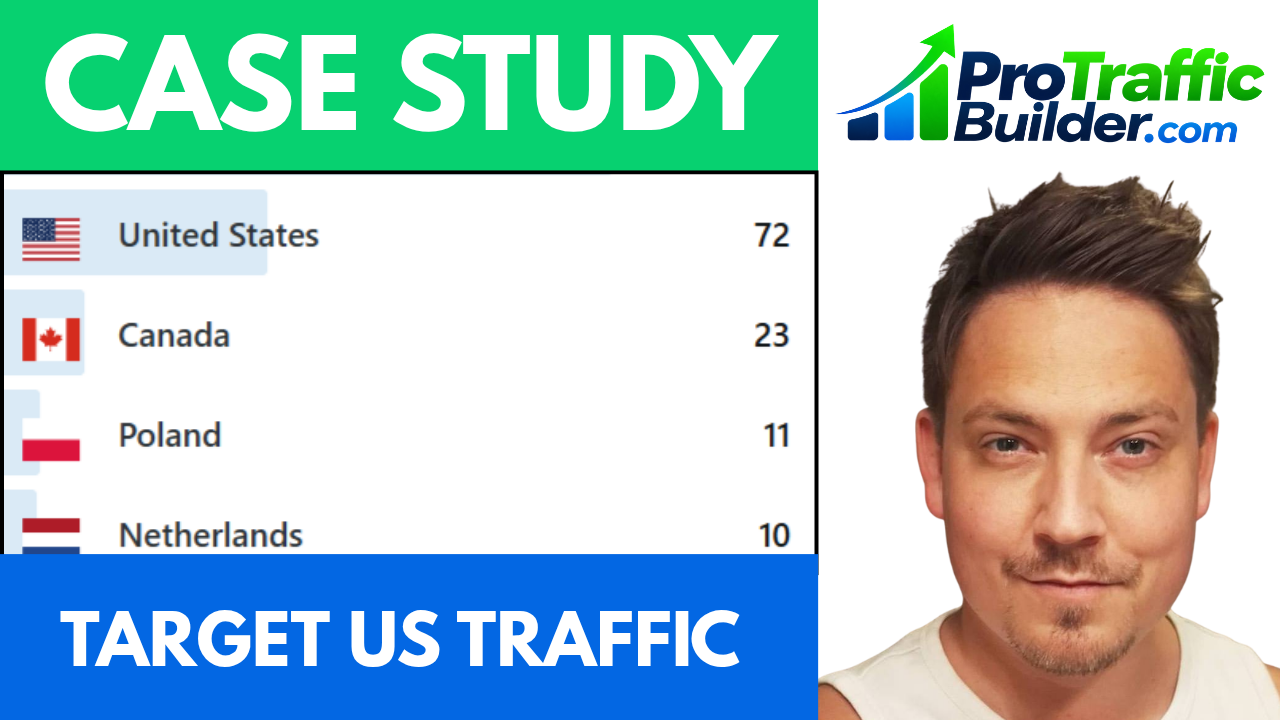
If you’re searching for how to get us traffic on website pages, here’s what we actually did. Instead of rebuilding the entire site or throwing money at random advertising campaigns, we treated US traffic like a growth experiment. We looked for existing demand, improved the pages that could capture it, then added several traffic sources around the same content.

The Starting Point: We Wanted More US Visitors
The problem was simple. The website already had useful content, but the traffic mix wasn’t giving us enough visitors from the United States.
That matters because traffic from different countries can behave very differently. Search demand, terminology, purchasing power, products available, local intent and even the questions people ask can vary by market.
So instead of asking, “How do we get more traffic?” we asked a much narrower question:
That change in thinking shaped everything that followed.
Step 1: We Looked for US Demand Before Creating More Content
Our first mistake would have been to publish 50 new articles and hope some of them attracted Americans.
We didn’t do that.
We started with the pages and queries the site already had. In Google Search Console, we filtered performance data by country and looked specifically at the United States. Search Console supports country filters such as country = USA, which makes it possible to isolate US search performance. Google’s Search Console documentation explains the filtering system.
What we looked for
| Signal | What it told us | What we did |
|---|---|---|
| US impressions | People in the US were already seeing the page. | Improved the page before creating something new. |
| Positions 5–20 | The page had visibility but room to gain clicks. | Improved intent match, title, headings and content depth. |
| High impressions + low clicks | The result was being seen but not attracting enough clicks. | Tested clearer search-result messaging. |
| US-specific queries | Searchers were using American terminology or intent. | Added genuinely useful US-specific examples. |
Step 2: We Optimized Existing Pages for US Search Intent
This became the foundation of the experiment.
For example, imagine an article about starting a side hustle. Instead of keeping the content completely generic, we could address searches such as:
- “best side hustles in the USA”
- “online side hustles for Americans”
- “best side hustles under $100”
- “how to start a side hustle in Texas”
- “US tax considerations for a specific type of side income” — where appropriate and with accurate information
The key is that each page needs to answer the searcher’s actual question. Google’s Search Essentials provides the baseline guidance for appearing in Google Search.
Use the language your US audience actually searches for.
Include prices, examples, terminology or availability only when relevant.
Strengthen answers, structure, internal links and search-result messaging.
We also avoided creating thin location pages simply because they contained a city or state name. If a page mentioned California, Texas or New York, it needed a real reason to exist.
Step 3: We Went Where US Audiences Were Already Talking
SEO takes time. We wanted another source that could potentially produce visitors while the search work was maturing.
That led us to communities.
Reddit was particularly useful for finding conversations around specific problems. But the strategy wasn’t “drop links everywhere.” It was the opposite.
Our community workflow
Search for questions related to the topic rather than searching only for places to post links.
Every community can have different rules about promotion.
Give a useful answer directly inside the discussion.
If a link genuinely adds more detail and the community allows it, include it naturally.
Reddit’s current spam guidance specifically warns against repeated or unsolicited mass engagement and says promotional activity needs to respect community rules. citeturn0search5turn0search10
Step 4: We Turned Existing Articles Into YouTube Content
We didn’t need to invent a completely new content machine.
One useful article could become a short video script, a longer YouTube video, several Shorts, social posts and a visual graphic.
For example, if the article was about getting website traffic, the video could be:
Video structure: Problem → 7 traffic sources → real examples → mistakes to avoid → link to the full guide.
YouTube’s own guidance recommends making descriptions useful and using relevant words that viewers might search for. Long-form video descriptions can also contain clickable external URLs when the channel has the required access. citeturn0search7turn0search1
That gave us another route into the website: someone could discover the topic on YouTube, watch the explanation, and then visit the detailed guide.
Step 5: We Added Pinterest and Visual Distribution Where It Made Sense
Not every niche is a natural fit for Pinterest. But when the subject has visual search intent, it can be another useful discovery channel.
Instead of publishing one graphic and stopping, we could create several useful visual angles from the same article:
- “10 Ways to Get US Website Traffic”
- “30-Day US Traffic Plan”
- “SEO vs Paid Traffic: Which Should You Test First?”
- “US Traffic Funnel Explained”
The important part was that each visual pointed to a useful page rather than being designed purely to generate empty clicks.
Step 6: We Built US Referral Traffic Instead of Waiting for Google
This was one of the biggest changes in the experiment.
We started looking for websites, newsletters, podcasts and creators whose audiences already matched the people we wanted to reach.
| Potential source | What we offered | Traffic angle |
|---|---|---|
| US blogs | Useful guest contribution or original resource | Referral clicks + brand discovery |
| Newsletters | Data, checklist or useful guide | Direct targeted visitors |
| Podcasts | Expertise/story/topic contribution | High-intent listeners |
| YouTube creators | Collaboration or supporting resource | Audience transfer |
| Resource pages | Relevant tool or guide | Evergreen referral traffic |
The pitch wasn’t “please give me a backlink.”
It was closer to: “Here’s something genuinely useful for your audience.”

Step 7: We Used Paid Traffic as a Controlled Test
Once we knew which topics people responded to organically, paid traffic became easier to test.
Instead of launching a huge campaign, we could take one proven topic and run a small, controlled US campaign.
Target high-intent searches and send them to the most relevant page.
Test proven search terms on another search network.
Test problem-focused creative against carefully selected US audiences.
Google Ads supports country, regional and other geographic targeting options, allowing advertisers to select the locations where campaigns can appear. citeturn0search0turn0search14
The important word here is test.
We weren’t trying to buy our way to thousands of visitors before knowing whether the page converted.
Step 8: We Added a Simple US Traffic Funnel
By this point, we stopped thinking of each channel as a separate project.
For example, one article could generate a YouTube script. The YouTube video could generate a short social clip. The article could answer Reddit questions. The same research could become a checklist. A useful statistic could become a visual.
That meant we were getting more mileage from the work we had already done.
Step 9: We Measured US Traffic Separately
We didn’t judge the experiment by total website traffic alone.
The primary measurement was traffic from the United States, then we looked at where those visitors came from and what they did after arriving.
| Metric | Why we tracked it |
|---|---|
| US organic clicks | Shows whether search visibility is turning into visitors. |
| US impressions | Shows whether Google is exposing pages to US searchers. |
| US referral sessions | Shows whether communities, sites and partnerships send visitors. |
| Landing page engagement | Helps identify whether the traffic is relevant. |
| Conversions | Traffic only matters if it supports the site’s actual goal. |
Search Console lets you filter and compare performance using dimensions such as country, query and page, which is particularly useful when you’re trying to isolate US search performance. citeturn0search2
US Traffic Goal Calculator
Use this to turn your traffic target into a simple daily number.
What We Would Do Differently If Starting Again
The biggest lesson wasn’t a particular platform.
It was sequencing.
We would spend less time creating brand-new content before understanding where US demand already existed. We would also test distribution earlier instead of assuming that publishing automatically creates traffic.
Find demand and distribution opportunities first.
Combine search with at least one faster distribution method.
Track whether US visitors actually engage, subscribe or buy.
The 30-Day US Traffic Sprint
If you want to copy the experiment, this is the sequence we’d use.
Open Search Console. Filter for United States. Record clicks, impressions, pages and queries.
Pick 3–5 pages with US impressions or rankings and improve their intent match, structure and usefulness.
Find relevant US conversations. Answer questions. Follow community rules. Avoid mass promotion.
Turn your strongest article into one useful YouTube video and supporting short-form clips.
Contact relevant US websites, newsletters, creators, podcasts and resource pages with something useful.
Choose one proven topic and run a controlled US campaign with a defined budget.
Compare US traffic by source. Keep what produces relevant visitors. Cut what doesn’t.
Build Your US Traffic Mix
Enter the number of monthly US visitors you want. The planner gives you an example distribution across channels.
The Main Lesson From the Experiment
So, how to get us traffic on website isn’t really about discovering one secret source of American visitors.
It is about creating several paths to the same useful website.
We started with existing demand. We improved pages that already had potential. We used communities to learn what people were asking. We turned content into video. We looked for relevant US referral sources. Then we used paid traffic as a controlled test rather than blindly buying clicks.
That approach also made the work easier to measure.
Existing content → US demand research → better search intent → community distribution → video → referrals → controlled paid tests → measure US visitors → repeat what works.
Frequently Asked Questions
What is the fastest way to get US traffic to a website?
Paid advertising can generate targeted US visits quickly because platforms such as Google Ads allow geographic targeting. Organic search, referrals and community traffic usually require more time to build.
Can a website outside the United States get US traffic?
Yes. Your physical location does not prevent people in the US from visiting a website. The important factors depend on the traffic source, audience intent, offer, content and geographic targeting.
How do I check whether my website already gets US traffic?
Use Google Search Console and filter performance data by country. Your analytics platform can also be used to analyze sessions and conversions by country.
Should I create separate US pages?
Only when there is a genuine reason. A page should add useful US-specific information rather than simply replacing a country name.
Can Reddit send US traffic?
Yes, but community rules matter. Helpful participation can expose your content to relevant audiences, while repetitive or unsolicited promotion can be treated as spam. Always check the rules of each community.
Can YouTube send visitors to my website?
Yes. Long-form YouTube video descriptions can contain clickable external URLs when the channel has the necessary access. YouTube also provides channel profile links and other linking options. citeturn0search1

Leave a Reply