
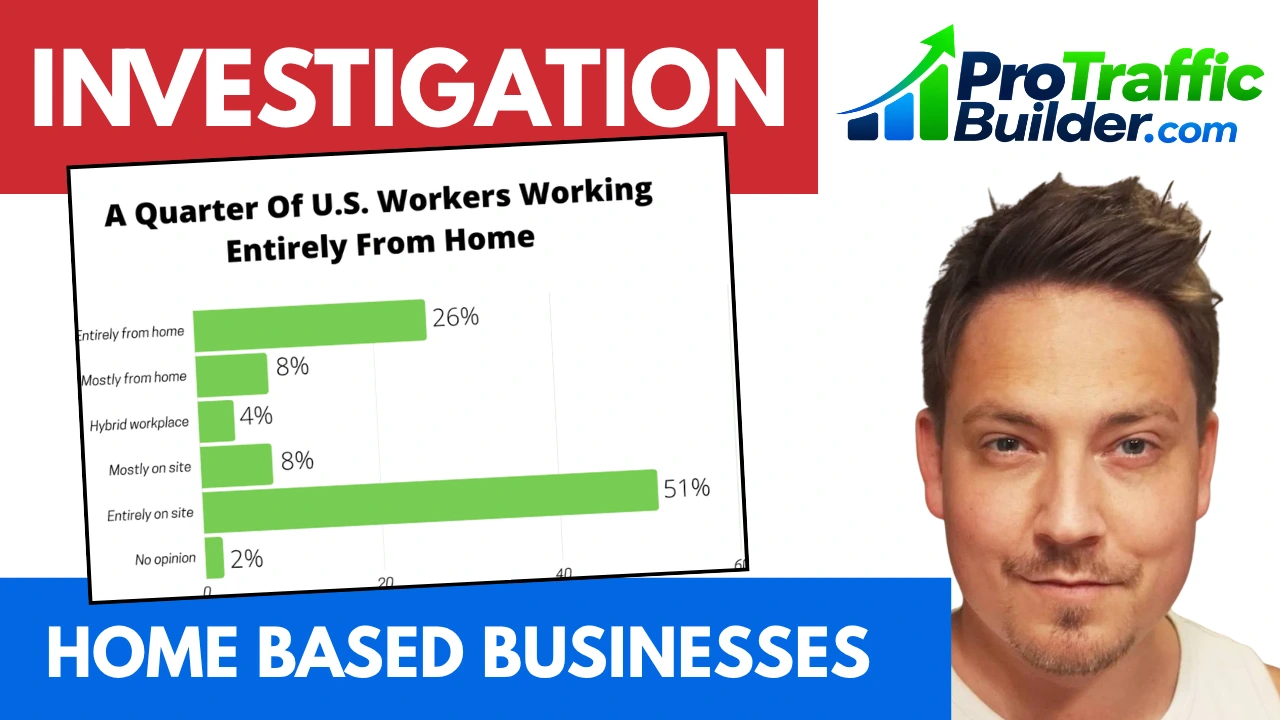
The promise sounds simple: work from your kitchen table, control your own schedule and build something that pays you instead of an employer.
But once you start looking closely at business opportunities from home in USA, the picture gets complicated.
One website tells you to become an affiliate. Another says you should publish books. Someone on YouTube is selling a course about ecommerce. A local-business guru says pressure washing is the answer. And somewhere in the middle of all of it, an MLM presentation is showing a photograph of a luxury car.
Which models are actually worth investigating?
That became the question behind this case study.
Rather than build another generic list of “ways to make money online,” we treated the subject like an investigation. We followed the money. We looked at who the customer is, what gets sold, where the traffic comes from, what happens after the first sale, and what can go wrong.
The result is a tour through 15 home-based business models — plus an illustrative case study showing how one person could test several of them without betting everything on the first idea.
- The case study: one home office, many possible businesses
- The four ways a home business makes money
- Affiliate marketing
- Self-publishing books
- Freelancing
- Consulting
- Digital products
- Ecommerce
- YouTube
- Courses and memberships
- Virtual assistance
- Agencies
- Local services
- Print-on-demand
- Micro-SaaS
- Content websites and newsletters
- MLM and direct selling
- The evidence table
- The decision point

The investigation starts where many home businesses start: finding customers.
The Case Study: One Home Office, Many Possible Businesses
Imagine a person we will call Jordan.
Jordan is not a celebrity entrepreneur. There is no venture capital. No warehouse. No team of 20 employees.
There is a laptop, a spare room, a few hundred dollars available for experiments and a willingness to learn.
Jordan has three skills: decent writing, basic digital marketing and the ability to explain complicated things clearly.
The obvious question is: “What business should Jordan start?”
But that question is too broad.
So Jordan writes down a different question:
That changes the investigation completely.
Affiliate marketing suddenly becomes a traffic-and-conversion business. Self-publishing becomes a reader-acquisition business. Freelancing becomes a customer-acquisition business. Software becomes a problem-selection business.
And MLM becomes a compensation-plan and customer-demand investigation.
Same home office. Completely different economics.
This is the theme running through the entire investigation: the business model matters, but distribution is what brings the model to life.
The Four Ways a Home Business Makes Money
After looking across the models, a pattern appears. Most home-based businesses are built around one or more of four engines.
Sell a Skill
Freelancing, consulting, virtual assistance and agencies turn expertise or labor into revenue.
Sell a Product
Books, digital products, ecommerce and print-on-demand turn an item into something customers can buy.
Build an Audience
Affiliate marketing, YouTube, newsletters and content sites monetize attention and trust.
Build an Asset
Software, content libraries, book catalogs and systems can keep producing value after the original work.
The strongest businesses often combine them.
A YouTube channel can sell a digital product. A book can send readers to an email list. An SEO agency can publish software tools. An affiliate website can publish its own comparison guide.
1. Affiliate Marketing: The Business of Being the Middleman
Jordan’s first experiment is affiliate marketing.
The appeal is obvious. There is no need to manufacture the product. The merchant handles checkout. Depending on the program, the merchant may also handle fulfillment, returns and customer support.
Jordan’s job is different: find people who have a problem, help them understand their options and send qualified buyers to the right product.
Article, video or post
Someone with a problem
Tracked referral
Qualifying action
The model looks simple until Jordan asks where the visitors come from.
That is the real business.
SEO can create search traffic. YouTube can create discovery. Pinterest, social media, email and communities can create other forms of distribution.
Affiliate relationships also come with disclosure obligations. The FTC says material connections such as affiliate relationships should be disclosed clearly and conspicuously. [FTC]
The case-study experiment
Jordan chooses one narrow subject rather than “everything people buy online.” The first goal is not thousands of visitors. It is finding evidence that a visitor will click and that the resulting traffic can produce a commission.
If that happens, the next question is scale.
If nobody clicks, Jordan does not immediately buy more traffic. The offer, audience or content needs investigation first.
Want to dig deeper into U.S. traffic?
Traffic is the engine behind many home-based online businesses. If you are building a website and want to understand how to attract visitors from the U.S., this guide is a useful next step: How to Get US Traffic on Your Website.
Where the work sits in affiliate marketing
Illustrative business-model visualization, not a profitability score.
2. Self-Publishing: Turning Knowledge Into a Catalog
The next experiment looks almost old-fashioned.
Jordan writes a book.
But the interesting part is what happens when one book becomes five.
Amazon Kindle Direct Publishing currently offers 35% and 70% ebook royalty options under specified conditions, and says print books can earn up to a 60% royalty while being printed on demand. [Amazon KDP]
That changes the inventory equation. A print-on-demand author does not have to order a garage full of books before discovering whether readers want them.
Problem-Solving Guide
One specific reader. One specific problem. One practical outcome.
Workbook
Exercises, checklists and prompts that help the reader do something.
Catalog
Several related books create more entry points into the same audience.
Author Brand
A book can lead to newsletters, courses, consulting or other products.
Jordan’s first mistake would be writing a 300-page book before finding out whether anyone cares about the topic.
The smarter case-study move is to validate the reader first.
What questions do they ask? What competing books already sell? What do reviews say is missing? What can this book explain better?
The book is the product. But discoverability is the business.
3. Freelancing: Sell the Skill You Already Have
At this point Jordan tries something radically simpler.
No audience.
No book catalog.
No ecommerce store.
Just a service.
Freelancing can be attractive because the transaction is easy to understand: a customer has a task or problem and pays for a defined service.
Writing, design, development, video editing, SEO, bookkeeping, research, translation and administrative support can all be delivered remotely.
The case-study lesson is speed.
A freelancer can potentially test an offer by speaking to prospective clients before spending months building an audience.
Then something interesting happens
Jordan notices that clients keep asking for the same service.
That repetition creates leverage.
Instead of starting every project from a blank page, Jordan documents the process. Templates appear. Checklists appear. Delivery becomes faster.
That is the bridge from freelancer to agency.
4. Consulting: Sell the Decision, Not Just the Deliverable
Consulting takes the same skill-based model one step further.
A client does not simply want something produced. They want help deciding what to do.
That might mean SEO strategy, marketing strategy, operations, technology, sales, hiring processes or another specialized area.
The investigation here is simple: does the customer’s problem have enough value that expert guidance is worth paying for?
If fixing the problem can save a business $20,000, spending money on expertise may be easier to justify than if the problem is worth $50.
This is why “what skill do I have?” is often a weaker question than “what expensive problem can I solve?”
5. Digital Products: Package the Shortcut
Jordan’s next experiment is a digital product.
A PDF guide. A template. A spreadsheet. A checklist. A research pack.
There is no shipping box.
But that does not mean there is no work.
The real product is the shortcut.
If the customer could figure something out in five hours, and your product helps them do it in 30 minutes, the file has value.
Digital products become especially powerful when attached to an audience. A creator can use free content to demonstrate expertise, then offer a paid shortcut for people who want the organized version.

The same distribution principle appears again: build something useful, then find the people who need it.
6. Ecommerce: When the Product Is Physical
Now the case study gets heavier.
Physical products introduce inventory, shipping, returns, packaging, payment fees and customer service.
But ecommerce has a powerful advantage: customers already understand the transaction.
They want the product. They pay. The product arrives.
A home-based ecommerce operation might sell handmade products, specialty goods, small-batch products, vintage items, curated bundles or products manufactured by a supplier.
The number Jordan watches
Not revenue.
Contribution margin.
A $100 sale is not a $100 profit. Product cost, fulfillment, payment processing, advertising, returns and other costs can consume a large part of the sale.
That is why ecommerce investigations often end up looking less glamorous than the Instagram version. The spreadsheet matters.
7. YouTube: Build an Audience Before You Monetize It
Jordan starts a channel.
The first videos make almost no money.
That is not necessarily a failure.
The early asset is the audience.
YouTube’s Partner Program gives eligible creators access to monetization features and ad revenue sharing, subject to eligibility and policy requirements. Current published requirements include 1,000 subscribers plus either 4,000 qualified public watch hours in the previous 12 months or 10 million qualified Shorts views in 90 days for the main YPP threshold described by YouTube. [YouTube]
But advertising is only one possible revenue stream.
Ads
Platform monetization once eligible.
Affiliate Links
Recommend relevant products.
Sponsorships
Brands pay for access to an audience.
Own Products
Courses, books, templates or services.
The case-study insight is that a creator business becomes more resilient when the audience is not dependent on a single revenue stream.
8. Online Courses and Memberships
Once Jordan has repeatedly answered the same questions, a course becomes possible.
But there is a trap.
It is easy to spend three months recording 40 lessons that nobody asked for.
A better investigation starts with the problem.
What does the audience repeatedly struggle with? What are they trying to achieve? What do they already know? What step keeps stopping them?
Then build the smallest teaching product around that problem.
9. Virtual Assistant Business
A virtual assistant business is almost the opposite of self-publishing.
You are not waiting for an asset to attract customers.
You are actively providing a service.
Email management, scheduling, research, customer support, data entry, content uploading and administrative work can all be packaged as services.
The case-study opportunity is specialization.
“I am a virtual assistant” is broad.
“I manage appointment scheduling and customer follow-up for dental practices” is much easier for a particular buyer to understand.
10. The Home-Based Agency
This is where the case study starts to compound.
Jordan has sold services. Now there are repeatable processes.
The next question is whether Jordan has to personally perform every task.
Learn the result
Sell the result
Document delivery
Delegate repeatable work
An agency can provide SEO, content, web design, paid advertising, video editing, social media, lead generation or other services.
The business changes when the owner begins managing a system rather than completing every deliverable.
That introduces new problems — hiring, quality control, communication and margins — but it also introduces another level of leverage.
11. Local Services: The Business Doesn’t Have to Be Online
This is the moment many “make money online” articles miss.
A business can be operated from home while serving customers somewhere else.
Cleaning. Pressure washing. Lawn care. Mobile detailing. Photography. Pet services. Home organization. Specialized maintenance.
The administrative office can be a spare room.
The customer does not care.
They care whether the problem gets solved.
That can make local services compelling to someone who prefers tangible work and direct customer relationships.
The SBA notes that licenses and permits can depend on the business activity and location, so “home-based” does not mean “regulation-free.” [SBA]
12. Print-on-Demand: Sell Designs Without a Warehouse
Jordan wants to sell physical products but does not want boxes of inventory.
Print-on-demand offers another route: create the design and let a fulfillment provider produce the item when an order arrives.
The challenge moves from inventory management to differentiation.
Generic designs are easy to copy and compete against. A design aimed at a very specific audience can be more interesting because the customer is buying identity as well as the object.
13. Micro-SaaS: Solve One Annoying Problem
Jordan’s most technical idea is also one of the smallest.
Not a giant platform.
A tool that does one annoying thing.
A calculator. A report generator. A scheduling tool. A niche dashboard. A data converter. A small automation.
The opportunity is simple to explain:
Software can create recurring revenue, but it introduces technical maintenance, support, security and customer-acquisition challenges.
The lesson is the same: solve the problem before building the giant product.
14. Content Websites and Newsletters
Jordan’s original affiliate project starts to look different after six months.
It is no longer just a collection of affiliate links.
It has become a media property.
Articles answer questions. A newsletter brings readers back. Product comparisons monetize buying intent. A digital product provides another revenue stream.
This is why content can be powerful: one audience can support several business models.
The downside is that search rankings, social algorithms and audience behavior can change. A content business needs distribution diversification just like an ecommerce company needs customer diversification.
15. MLM and Direct Selling: Follow the Compensation Plan
At this point, the investigation reaches one of the most controversial categories of home-based business opportunity.
Multi-level marketing.
We deliberately put this model beside the others rather than making it the entire story.
An MLM can involve direct product sales, participant recruitment and compensation tied to a company’s plan. The FTC says the legal analysis of an MLM’s structure is fact-specific and focuses on how the compensation system operates and what it rewards.
There are documented people who have reached high recognition levels in MLM organizations.

A founder-level MLM success example supplied for this case study. Individual success does not establish typical participant results.
That is important to acknowledge.
It is equally important to ask what happened to everyone else.
In 2024, FTC staff reviewed 70 publicly available MLM income disclosure statements. The review found that most of the statements excluded or obscured low- or no-earning participants and often failed to account for participant expenses. A separate FTC summary said the reviewed disclosures showed most participants making $1,000 or less per year, and that in at least 17 of the MLMs reviewed, most participants did not make any money at all. [FTC]
The Question We Would Ask Before Joining
Not: “Can someone make a lot of money?”
The answer to that can be yes while still being irrelevant to the typical participant.
The better questions are: How many participants earn money? What is the median? What are the expenses? Who are the retail customers? What does the compensation plan reward?
This is the same investigative standard we use for every other model. Follow the money.
The Evidence Table: What Each Model Actually Requires
| Model | What is sold? | Where customers come from | What creates leverage? | What deserves scrutiny? |
|---|---|---|---|---|
| Affiliate marketing | Recommendations | Search, social, email, video | Content library and audience | Traffic quality and conversion |
| Self-publishing | Books | Marketplace/search/audience | Catalog | Discoverability and royalties |
| Freelancing | Skill/time | Outreach, platforms, referrals | Systems and specialization | Capacity and client acquisition |
| Consulting | Expertise | Authority, referrals, outreach | Reputation and repeatable frameworks | Credibility and measurable value |
| Digital products | Knowledge/tools | Audience and search | Reusable delivery | Demand and differentiation |
| Ecommerce | Physical products | Search, ads, marketplaces, social | Brand and repeat customers | Margins and acquisition costs |
| YouTube | Attention | Platform discovery | Audience and content library | Platform dependence |
| Courses | Education | Audience and authority | Reusable curriculum | Actual learner demand |
| Virtual assistance | Remote support | Outreach and referrals | Specialization and delegation | Time capacity |
| Agency | Managed service | Sales and referrals | Team and systems | Margins and quality |
| Local service | Physical result | Local search, referrals | Routes, repeat customers, team | Licensing and operations |
| Print-on-demand | Merchandise | Marketplaces and audience | Design catalog | Competition and margins |
| Micro-SaaS | Software | Search, partnerships, outreach | Recurring software delivery | Development and churn |
| Content site | Information/audience | Search, social, email | Content library | Traffic volatility |
| MLM | Products + participation in compensation plan | Retail customers and network | Team/network structure | Compensation economics and participant outcomes |
The Biggest Discovery: “Home-Based” Is Not the Business Model
That phrase describes where you work.
It does not tell you how you make money.
That distinction sounds obvious, but it explains why lists of “home business opportunities” can become so confusing.
Affiliate marketing and self-publishing are both home-based.
So are an SEO agency and a cleaning company.
But their economics are completely different.
One sells attention. One sells intellectual property. One sells expertise. One sells physical labor and a local result.
The useful question is not which category sounds most exciting.
It is which economic engine fits your abilities, resources and preferred way of acquiring customers.
The Four Engines
Conceptual visualization only. It is not a ranking of profitability or success probability.
Interactive Case-Study Matcher
Imagine you are Jordan. Pick the statement closest to your starting point.
The Decision Point: What Would Jordan Actually Do?
After investigating all 15 models, Jordan does something surprisingly unglamorous.
Jordan does not launch all 15.
Jordan picks one problem.
The first test is deliberately small.
If the skill is already valuable, start with a service.
If the person loves writing, test a narrow information product or publishing idea.
If the person enjoys audience building, test content and affiliate economics.
If the person understands products, test a small ecommerce offer.
If the person is technical, find one repetitive problem that software can remove.
If the person prefers local work, find an expensive or annoying local problem.
The first objective is not to build the final company.
It is to get evidence.
The evidence ladder
This framework is useful because it prevents a common mistake: confusing attention with demand.
Thousands of views can be interesting.
A paying customer is stronger evidence.
Where Taxes, Licenses and the Boring Stuff Enter the Story
Eventually Jordan discovers that a home business is still a business.
The U.S. Small Business Administration explains that licenses and permits vary by location and business activity. [SBA]
The IRS also has specific rules around business use of a home. Publication 587 explains that qualifying home-business use can involve requirements such as exclusive and regular use, with specific exceptions and limitations. [IRS]
That means the “I work from my spare bedroom” part is only the beginning.
Recordkeeping, taxes, licenses, insurance, contracts and consumer-protection rules can all matter depending on the business.
What We Would Not Trust at First Glance
During the investigation, one pattern kept appearing.
The more an opportunity depends on a beautiful lifestyle story, the more important it becomes to inspect the underlying economics.
We would slow down when we see:
- Guaranteed income.
- Pressure to buy immediately.
- Large upfront payments with vague explanations.
- Testimonials presented as though they represent typical results.
- Revenue figures presented without expenses.
- A business that cannot explain who the paying customer is.
- A product nobody appears to want outside the opportunity itself.
- “Passive income” claims that hide the amount of work required to build the asset.
The FTC’s MLM investigation is a useful reminder of this principle. Its staff found that many MLM income disclosures emphasized high earnings while failing to make low or zero earnings and expenses sufficiently clear. [FTC]
Frequently Asked Questions
What are the best business opportunities from home in USA?
There is no universal best option. Strong categories include affiliate marketing, self-publishing, freelancing, consulting, digital products, ecommerce, YouTube, online education, virtual assistance, agencies, local services, print-on-demand, software, content businesses and direct selling. The fit depends on skills, capital, customer access and the way you prefer to work.
What is the easiest home-based business to test?
A narrowly defined service can often be tested quickly because you can offer it before building inventory or a large audience. That does not guarantee easy customer acquisition, but the feedback loop can be short.
Can self-publishing become a real business?
Yes. Self-publishing can become a catalog business rather than a one-book experiment. KDP currently offers 35% and 70% ebook royalty options under specified conditions and print-on-demand publishing. [Amazon KDP]
Can affiliate marketing be operated from home?
Yes. The core activities — research, content creation, audience building and referral management — can generally be performed remotely. Affiliate relationships should be disclosed clearly. [FTC]
Is YouTube a business or just a content platform?
It can be either. For creators who build an audience, YouTube can become a distribution channel for advertising, affiliate offers, sponsorships, products, memberships and services. Monetization features have specific eligibility requirements. [YouTube]
Are MLMs legitimate business opportunities?
MLMs are a category of direct-selling business model, but individual companies and compensation structures should be investigated separately. The FTC says legality is fact-specific and has highlighted problems in how many MLM income disclosures present low earnings and expenses. [FTC]
Do I need an LLC to work from home?
Not necessarily. Business structures and requirements vary. Check the current rules for your state and situation, and consider professional advice where appropriate.
The Final Finding
After following the money through all these models, the biggest surprise is how little the phrase “work from home” tells you.
It tells you where the business operates.
It does not tell you whether the business sells expertise, products, attention, software, local labor or a network.
That is the part worth investigating.
And it leads to a much better way of thinking about the most successful home-based businesses available today.
Don’t start by asking which business is hottest.
Start by asking which customer problem you can solve unusually well.
Then choose the business model that gives you the clearest path to that customer.
The Case Study Ends Where the Real Business Begins
Jordan closes the spreadsheet.
There is no magic business model.
There is no secret button.
There is simply a problem, a customer, an offer and a way to reach them.
The next move is small: make the offer, put it in front of real people and see what happens.
That is how an idea becomes evidence — and evidence is what you need before you build the bigger business.
Sources
- Federal Trade Commission — MLM Income Disclosure Review
- Federal Trade Commission — Business Guidance Concerning MLM
- Federal Trade Commission — Endorsement Guides
- Amazon Kindle Direct Publishing — Royalties
- YouTube — Partner Program Overview
- U.S. Small Business Administration — Licenses and Permits
- IRS — Publication 587: Business Use of Your Home
Educational information only. Business, tax, licensing and regulatory requirements vary by situation and location.

Leave a Reply